
Spring in Sydney brings jacaranda blooms and longer evenings. For many of the people I see at Ayurvedic Wellness Centre, it also brings a blocked nose and a heavy, sluggish feeling that lingers well into November.
Ayurveda spring guidance treats this season as your body’s natural moment to lighten up after winter. In this guide I share the food, daily habits, movement and treatments I recommend to my patients each September to November.
Everything here is general information to support your wellbeing. It does not replace your GP, and it works best alongside the care you already receive.
What spring (Vasanta Ritu) means in Ayurveda
Vasanta Ritu is the Ayurvedic name for spring, one of six seasons described in the classical texts. In India, it runs from mid-March to mid-May, so here in Australia I map it onto our spring months of September, October and November.
Ayurveda groups the guidance for each season into Ritucharya, a seasonal regimen of diet and lifestyle designed to keep you in step with the weather around you.
Why Kapha takes centre stage in spring
Kapha is one of the three doshas, the mind-body principles Ayurveda uses to describe how you function. It carries the qualities of earth and water: heavy, cool, steady and moist.
Through winter, Kapha builds up as you eat richer food and move less. When the spring sun warms the air, the classical texts describe this stored Kapha as melting, like snow on a mountain.
That melting is why Ayurveda sees spring as a season of congestion and heaviness. Your agni, or digestive fire, also tends to dip as Kapha dampens it. Spring is the traditional season for gentle cleansing.
Common spring health issues and why they happen
Hay fever, sinus congestion and a slow, heavy feeling top my list of spring complaints. From an Ayurvedic view, each one traces back to melting Kapha clogging the channels of your head, chest and digestion.
Hay fever and sinus congestion
Hay fever (allergic rhinitis) affects one in four Australians and is commonly triggered by spring pollen. Spring hay fever deserves respect in south-eastern Australia. Victorians face a high-risk window for thunderstorm asthma between October and December, when grass pollen peaks. A storm in those months can bring on severe breathing trouble fast.
This can happen even if you have never been diagnosed with asthma but have springtime hay fever. If you wheeze or feel short of breath, please see your GP and ask about an asthma action plan. No herb or massage replaces that plan.
Sluggish digestion, weight and low energy
When Kapha dampens your agni, meals sit heavily and your energy drops after lunch. Many people notice a little winter weight that refuses to shift, along with a foggy, unmotivated mood.
Skin flare-ups
Some of my patients see eczema or breakouts flare as the weather warms. Ayurveda links this to Kapha mixing with rising Pitta, the dosha of heat, as the season moves towards summer.
Ayurveda spring diet: what to eat and what to ease off
An Ayurveda spring diet is light, warm and dry. It favours bitter, pungent and astringent tastes because they counter the heaviness of Kapha.
Think of it as the opposite of your winter comfort food: meals your digestion handles with ease.
Foods to favour
These foods suit the season well and are easy to find at any Australian greengrocer:
- Grains: Barley, millet and buckwheat, plus quinoa or well-aged rice.
- Legumes: Split mung beans and red lentils, which are lighter than kidney beans or soybeans.
- Vegetables: Leafy and bitter greens such as rocket, kale and silverbeet. Asparagus and broccoli are also good choices.
- Fruit: Apples, pears and berries in moderate amounts. Very sweet tropical fruit sits better in summer.
- Spices: Ginger, black pepper and turmeric warm your digestion. Cumin and coriander make gentle everyday companions.
- Sweetener: A small amount of raw honey, the traditional sweetener for Kapha season. Add it to warm food or drinks rather than hot ones, as Ayurveda advises against heating honey.
Foods to ease off
Kapha builds up from heavy, cold and oily foods, so cut back on the following for a few weeks:
- Ice-cold drinks and frozen desserts.
- Heavy dairy such as cheese, ice cream and thick yoghurt.
- Deep-fried and very salty food.
- Refined sugar and large portions of bread or pastries.
Meal timing
When you eat matters as much as what you eat. Make lunch your main meal when your digestion is strongest, and keep dinner small and early.
Try to leave three to four hours between meals rather than snacking all afternoon. Warm water or ginger tea between meals helps you feel satisfied without adding heaviness.
Ayurveda recipes for spring
These two Ayurveda recipes for spring are the ones I give patients most often. Both are simple enough for a weeknight and fit neatly into an Ayurveda spring diet.
Spring mung bean kitchari
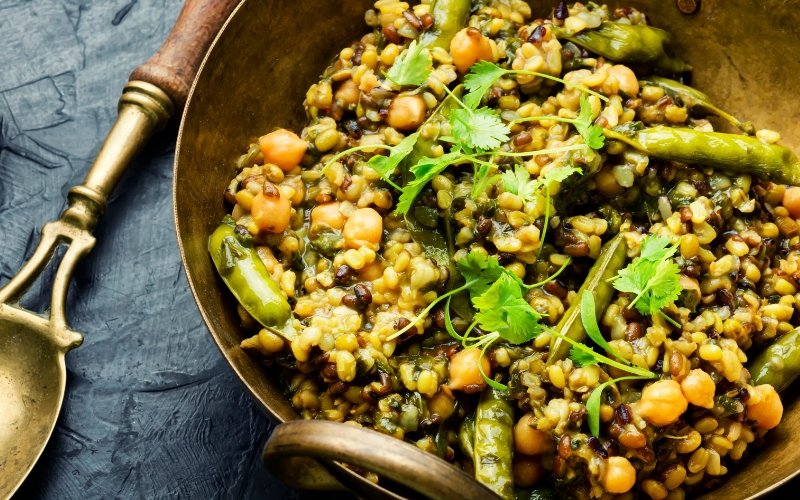
Kitchari is a one-pot meal of rice and split mung beans that Ayurveda treasures for how easily it digests. Here is how I make a lighter spring version for two:
- Rinse half a cup of split yellow mung beans and a quarter cup of basmati rice until the water runs clear.
- Warm one teaspoon of ghee or sesame oil in a pot and add half a teaspoon each of cumin seeds and mustard seeds.
- When the seeds pop, stir in one teaspoon of grated fresh ginger and half a teaspoon of turmeric.
- Add the rice, mung beans and four cups of water, then simmer for 30 to 40 minutes until soft.
- Fold in a handful of chopped silverbeet or kale for the last five minutes.
- Finish with black pepper, a squeeze of lemon and fresh coriander.
Warming spice tea
This tea is my go-to for patients who wake up feeling congested. Here is how to make two cups:
- Bring two cups of water to the boil with four thin slices of fresh ginger.
- Add half a teaspoon each of cumin, coriander and fennel seeds.
- Simmer for five minutes, then strain and let it cool slightly.
- Stir in half a teaspoon of raw honey once the tea is warm rather than hot.
Ayurveda spring cleanse and detox
An Ayurveda spring cleanse is a period of simpler eating and gentler living that rests your digestion. Ayurveda describes the sticky residue of weak digestion as ama, and a cleanse aims to reduce it.
Classical Ayurveda goes further with Panchakarma, a set of five cleansing therapies delivered under medical supervision. Vamana, a supervised therapeutic emesis, is the classical spring therapy for clearing excess Kapha.
Clinical research on seasonal purification therapies such as Vamana remains limited, so I approach them with care. Vamana is never a home remedy. At Ayurvedic Wellness Centre, Panchakarma is prescribed only after a consultation with one of our Ayurvedic doctors.
In a small 2025 pilot of a 14-day Panchakarma program, 12 women improved on physical and quality-of-life measures, with the biggest shifts among Kapha types. Twelve people and no comparison group cannot prove much, so please read that as encouraging rather than conclusive.
A gentle at-home Ayurveda spring detox
A home-based Ayurveda spring detox can be as simple as three to five days of lighter eating. Here is the gentle approach I suggest for healthy adults:
- Eat kitchari for one or two meals a day, with steamed vegetables on the side.
- Sip warm water or spice tea through the day instead of cold drinks.
- Skip alcohol, refined sugar and heavy dairy.
- Go to bed by 10 pm and rise by 6 am.
- Keep exercise gentle, such as walking or yoga.
Please skip any cleanse if you are pregnant, breastfeeding or recovering from illness. The same applies if you live with diabetes, an eating disorder or another chronic condition, unless your GP agrees.
Daily routine (Dinacharya) for spring
Dinacharya is the Ayurvedic daily routine, and in spring its focus shifts to waking early and moving stagnant Kapha.
Rise before 6 am
Ayurveda divides the day into dosha periods, with 6 to 10 am governed by Kapha. Waking before 6 am helps you start the day light rather than groggy, and it is the change my patients notice most.
Daytime naps add to Kapha’s heaviness. Save your sleep for the night whenever you can.
Tongue scraping and oil pulling
Start with a copper or stainless steel tongue scraper to clear the coating that builds overnight. Then try oil pulling: swish a tablespoon of sesame oil in your mouth before spitting it into the bin, not the sink.
In a 2025 randomised trial of sesame oil pulling, 40 adults who pulled for 15 minutes each morning for eight weeks reduced their plaque scores by about 19%, compared with about 10% for distilled water. Bias could not be ruled out in that trial, so treat oil pulling as an extra to brushing and flossing rather than a replacement.
Dry brushing
Garshana is dry brushing with raw silk gloves, a traditional spring practice for waking dull Kapha-type skin. Use light, brisk strokes towards your heart for a few minutes before you shower.
Self-massage (Abhyanga) with lighter oils
Abhyanga is warm oil self-massage, and in spring I suggest using less oil than in winter. Choose sesame or mustard oil and use brisk strokes along your limbs.
In a 2026 randomised controlled trial, 42 young men who added five minutes of daily sesame oil leg massage to their stretching gained more hamstring flexibility than those who only stretched. The trial included only young men and was not blinded, so it is an early but promising signal.
Nasal care with Nasya and nasal rinses
Nasya is the Ayurvedic practice of placing a few drops of herbal oil in each nostril to support the nasal passages. Many of my patients pair it with a saline nasal rinse during pollen season.
Across 23 studies and 3,584 people in a 2025 network meta-analysis, several nasal rinse solutions eased hay fever symptoms more than placebo. Always use sterile, distilled or boiled and cooled water for your nasal rinse; never use water straight from the tap.
If you have had recent nasal surgery or get frequent nosebleeds, check with your GP before trying Nasya at home.
Exercise and movement for spring
Spring is the season to move more vigorously than in winter. Kapha responds to effort and a little sweat, so aim for activity that lifts your heart rate most days of the week.
These forms of movement suit the season particularly well:
- Brisk walks or hikes, such as the Bondi to Coogee coastal walk in the morning light.
- Sun salutations, which warm the whole body in a few minutes.
- Backbends and twists that open the chest and stimulate digestion.
- Cycling, swimming or a dance class for variety.
Break up long sitting periods with a short walk or a few stretches every hour.
Breathwork (Pranayama)
Pranayama is the yogic practice of breath control, and spring is a lovely time to build a daily habit. Ujjayi, or ocean breath, gently warms the body and steadies the mind.

Kapalabhati, a fast and forceful breath, is traditionally used to clear Kapha. Across six randomised trials with 517 participants, Pranayama added short-term benefits to mental health care.
Rapid techniques caused more unwanted reactions in those trials than slow, steady ones. Learn Kapalabhati from a qualified teacher, and skip it if you are pregnant or have high blood pressure.
Herbs and supplements for spring
Ayurveda draws on warming, drying herbs in spring, but treat them with the same respect as any medicine.
Buy only Australian-regulated products
Every Ayurvedic medicine sold legally here sits on the national register of complementary medicines, holding it to the same quality bar as any other medicine. Unregistered Ayurvedic imports have caused lead poisoning cases in Australia, and bringing them in or selling them breaks the law.
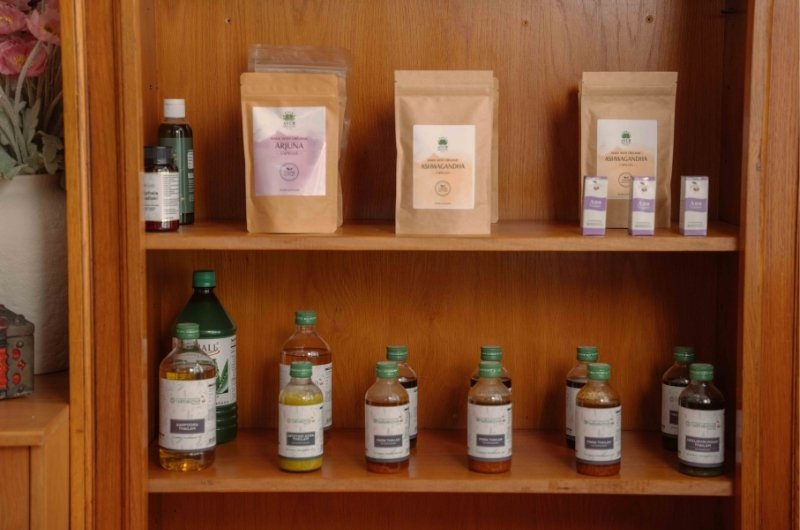
Look for an AUST L or AUST R number on the label before buying. Avoid ordering Ayurvedic medicines from overseas websites or social media.
Ayurvedic herbs for spring
These are the herbs most often used in spring, with what the evidence currently shows:
- Turmeric: Cooking with turmeric or sipping it in a tea poses little risk for most people. Supplements are stronger, and they may raise your bleeding risk if you take blood thinners.
- Ginger: Ginger carries a low risk for most people and helps with morning sickness and post-surgery queasiness. It may increase bleeding risk, so check with your doctor if you take anticoagulants.
- Tulsi: Tulsi appears safe for most people for up to eight weeks, though high-quality human studies are still lacking. Avoid it if you are pregnant, trying to conceive, breastfeeding or managing hypothyroidism.
- Triphala: This classic blend of three fruits is a gentle digestive support in Ayurveda. Across 15 trials pooled in a 2025 meta-analysis, its effects on body weight were modest and inconsistent, so I never present it as a weight-loss product.
- Trikatu: This traditional blend of ginger, black pepper and long pepper is used to kindle digestion in Kapha season. It is strongly heating, so it does not suit everyone.
Herbs can interact with prescription medicines. Please tell your GP and pharmacist about anything you take, and let an Ayurvedic doctor tailor the choice to you.
Mind and emotional wellbeing in spring
Spring Kapha can feel like emotional heaviness: low motivation, extra sleepiness and a pull towards comfort food. Ayurveda counters that heaviness with stimulation, novelty and a fresh routine.
These small practices help many of my patients feel brighter through the season:
- Ten minutes of meditation after your morning walk.
- Bright colours in your clothing and home, such as yellow, orange and green.
- Uplifting scents like eucalyptus, rosemary or lemon in a diffuser.
- Decluttering one drawer or cupboard each weekend.
- Setting one simple intention for the season and writing it down.
Sleep matters for mood too, so aim to be in bed by 10 pm to rise early without fighting fatigue.
Persistent low mood is not something to push through alone. If sadness or worry lasts more than two weeks, please speak with your GP or call Lifeline on 13 11 14.
Lifestyle and environment
Your surroundings can feed Kapha or help clear it, so spring is a good time to refresh your home and habits.
Dress for changeable weather
Sydney spring can swing from warm sun to a cold southerly in a single afternoon. Keep a light layer with you because Ayurveda considers sudden chills a common trigger for spring colds.
Spring clean your space
In Ayurveda, a cluttered and damp home mirrors a heavy, stagnant body. Open windows on low-pollen days, wash bedding in hot water and clean mouldy corners thoroughly.
Plan around pollen
If you live with hay fever, check your local pollen forecast before outdoor exercise. On high-pollen or stormy days move your workout indoors.
Respect the change of season
Ayurveda calls the two weeks between seasons Ritu Sandhi, the seasonal junction. Shift your habits gradually during this window instead of overhauling everything at once.
Ayurvedic massages and treatments to get you ready for spring
In-clinic treatments go deeper than home routines, and in spring I tailor them to lighten Kapha. Each one begins with a conversation about your health, medications and goals.
Abhyanga full-body massage
Abhyanga is a full-body warm oil massage performed by our trained therapists. In spring we choose lighter, warming oils and faster strokes to suit Kapha.
Udvartana herbal powder massage
Udvartana massage uses dry herbal powders massaged firmly in an upward direction. Ayurveda reserves it for Kapha seasons because its dry, stimulating quality is the opposite of heavy Kapha.
Kizhi herbal pouch massage
Kizhi combines head massage and Abhyanga with warm pouches filled with 18 therapeutic herbs. It suits people who feel stiff and sluggish as the weather changes.
Nasya treatment
In-clinic Nasya includes gentle facial massage and steam before herbal oil drops are placed in the nostrils. I often suggest it in pollen season if you feel blocked and heavy-headed.
Panchakarma
Panchakarma is our most comprehensive cleansing program, and it is only prescribed by an Ayurvedic Wellness Centre doctor after a full assessment. It is a significant commitment, so we talk through preparation, diet and aftercare well before you begin.
Your spring starts with small steps
You do not need to change everything at once to feel the benefit of an Ayurveda spring routine. Pick two or three ideas from this guide, like an earlier alarm and a bowl of kitchari, and give them two weeks.
If you would like a plan built around your constitution, book a consultation with our team at Ayurvedic Wellness Centre in Bondi Junction. Please keep your GP in the loop, especially if you have asthma, take regular medication or are pregnant.
The first version of this article was published on Feb 9, 2016.
Sources
- ARISE Allergic Rhinitis Trial – https://allergy.org.au/about-ascia/info-updates/arise-allergic-rhinitis-trial
- Thunderstorm asthma | Better Health Channel – https://www.betterhealth.vic.gov.au/thunderstorm-asthma
- Ritucharya: A Preventive and Promotive Ayurvedic Regimen for Lifestyle Disorders – https://jaims.in/jaims/article/view/4912
- Ritu Shodhana in Ayurveda: A Systematic Review of Seasonal Purification for Health and NCD Prevention – https://www.nepjol.info/index.php/bheshaja/article/view/93595
- The Effect of Ayurvedic Panchakarma Therapy on Body Mass Index, Blood Parameters, and Quality of Life in Individuals of Different Constitutional Types: A Pilot Study – https://journals.lsu.lt/reabilitacijos-mokslai/article/view/1735
- The plaque reducing efficacy of oil pulling with sesame oil: a randomized-controlled clinical study – https://link.springer.com/article/10.1007/s00784-024-06134-y
- Effect of Nitya-Abhyaṅga (self-massage) combined with stretching on hamstring extensibility, muscle stiffness, and stretch tolerance in college students: a randomized controlled trial – https://www.frontiersin.org/journals/sports-and-active-living/articles/10.3389/fspor.2026.1800782/full
- Efficacy of different nasal irrigation treatments versus placebo in allergic rhinitis: a systematic review and network meta-analysis – https://www.frontiersin.org/journals/pharmacology/articles/10.3389/fphar.2025.1670372
- Effectiveness of pranayama for mental disorders: a systematic review and meta-analysis of randomized controlled trials – https://www.frontiersin.org/journals/psychiatry/articles/10.3389/fpsyt.2025.1616996/full
- Imported Ayurvedic products found to contain dangerous heavy metals – https://www.tga.gov.au/safety/safety-monitoring-and-information/safety-alerts/imported-ayurvedic-products-found-contain-dangerous-heavy-metals
- Global traditional medicine strategy 2025-2034 – https://www.who.int/publications/i/item/9789240113176
- Turmeric | Memorial Sloan Kettering Cancer Center – https://www.mskcc.org/cancer-care/integrative-medicine/herbs/turmeric
- Ginger – Special Subjects – MSD Manual Consumer Version – https://www.msdmanuals.com/home/special-subjects/dietary-supplements-and-vitamins/ginger
- Holy Basil – Special Subjects – MSD Manual Consumer Version – https://www.msdmanuals.com/home/special-subjects/dietary-supplements-and-vitamins/holy-basil
- The Anti-Obesity Effects of Triphala and Triphala Guggul: A Systematic Review and Meta-Analysis of Clinical Trials – https://www.sciltp.com/journals/jmnp/articles/2509001619