
Burnout rarely announces itself. It creeps in quietly while you keep showing up for work, family and everyone else, until one day you notice you no longer feel like yourself.If th at sounds familiar, you are far from alone. Stress and burnout have become part of everyday life for many Australians, and the signs often appear in your sleep and mood long before you put a name to them.
Ayurveda, the traditional system of medicine from India, offers a gentle way to respond. Rather than treating each symptom on its own, it looks at the root cause and at your individual constitution. Then it brings in small daily rituals that may help restore your sense of balance.
This blueprint walks you through how Ayurveda understands stress, why the same pressure lands differently on different people, and five simple practices you can start this week.
Why stress and burnout feel so common in Australia right now
Stress and burnout are among the most widespread health concerns for Australian workers. The Key Work Health and Safety Statistics Australia 2026 put mental health conditions at 12% of serious workers’ compensation claims. That figure represents a rise of 169% over the past decade.
Your nights carry the strain too. The Sleep Health Foundation’s Aussie Sleep Snapshot Survey 2026 put average sleep at 6.9 hours a night. More than half of Australians (54.2%) do not sleep well on three or more nights each week, and 36.9% of workers say work-related factors contribute to those restless nights.
A busy mind topped the list of everyday sleep disruptors at 41.1%, followed by worry or anxiety at 35.5%. None of this happens overnight; that is the most hopeful part of the story.
How burnout builds one small signal at a time
Burnout rarely arrives in a single moment. It grows as small signals slowly become normal, often in a pattern like this:
- Skip lunch: You squeeze in one more client or one more task.
- Run on coffee: Feeling tired becomes your new normal.
- Work late: Feeling wired starts to replace feeling rested.
- Ignore the signs: Poor sleep, low mood and unsettled digestion get pushed aside.
- Depletion: You catch yourself saying, “I don’t feel like myself.”
Your body communicates long before complete depletion. Learning to notice those early messages gives you more room to respond with care.
What Ayurveda means by stress
In Ayurveda, stress is anything that asks your body and mind to adapt. That might be a difficult conversation, long hours, poor sleep or constant notifications.
The word Ayurveda comes from Sanskrit: ayur means life and veda means knowledge or science. This traditional system of medicine from India views body, mind and environment as interconnected. It focuses on prevention and daily rhythm. Your practitioner tailors food, herbs, lifestyle and meditation to you instead of offering one routine for everyone.
Stress tends to arrive through four doorways:
- Physical: standing all day and skipping meals.
- Mental: decisions, deadlines and the effort of focusing.
- Emotional: grief, conflict and holding space for others.
- Sensory: noise, screens and constant stimulation.
Stress also shows through whichever system struggles most to adapt. You might feel wired at night or notice changes in your appetite and digestion. Some people notice more hair shedding or skin sensitivity during demanding periods. Others feel anxious and irritable, or foggy and drained.
From an Ayurvedic view, stress is not the enemy. It is information, and it points you toward what needs care.
Look beneath the symptom
Before Ayurveda asks what you should do, it asks why a symptom appeared. This principle is called Nidana, which means looking for the root cause.
Three questions can guide you:
- What changed? Look at shifts in your sleep and workload, or in your diet, environment and relationships.
- When did it begin? Look for timing, triggers and transitions.
- What repeats? Patterns often reveal the cause.
If you only quiet the symptom, you may miss the story beneath it.
Knowing what you need and choosing the opposite
Ayurveda calls this Prajnaparadha: knowing what you need and choosing the opposite anyway. It rarely appears as one big decision. It appears as repetition.
Lunch becomes one more client. Rest becomes one more email, and sleep becomes one more scroll. Your boundaries yield to one more yes.
Each of these choices draws on two resources that Ayurveda considers central to resilience.
Prana and Ojas: your energy and your reserves
Prana and Ojas are two Ayurvedic concepts that help explain how stress turns into burnout. Prana describes your moment-to-moment energy and attention, while Ojas describes your deeper reserve of resilience.
Prana, the body’s communication network
In Ayurveda, Prana governs your breath and movement as well as your focus and how you respond. When Prana is balanced, you tend to feel present, creative and adaptable. When it is scattered, you may notice racing thoughts and shallow breathing.
Ojas, your reserve of resilience
Ojas helps you recover, resist and remain steady. Think of Ojas as a bank account your daily habits either fill or drain. Deposits include restful sleep, warm and nourishing meals, and recovery time between demands. Connection, joy and a consistent daily rhythm add to the balance too.
Withdrawals include chronic stress, skipped meals and poor sleep. Constant stimulation and giving without restoring drain it further. Burnout is a long period of spending more than you restore.
From adaptation to depletion
Ayurveda describes burnout as a pathway that unfolds in stages:
- Constant adaptation to demands.
- Scattered Prana.
- Your body draws on deeper reserves.
- Ojas depletes.
- Burnout.
The encouraging part is that recovery is not reserved for holidays. You can build it into ordinary moments. First, it helps to understand why stress lands so differently on each of us.
Why the same stress affects you differently
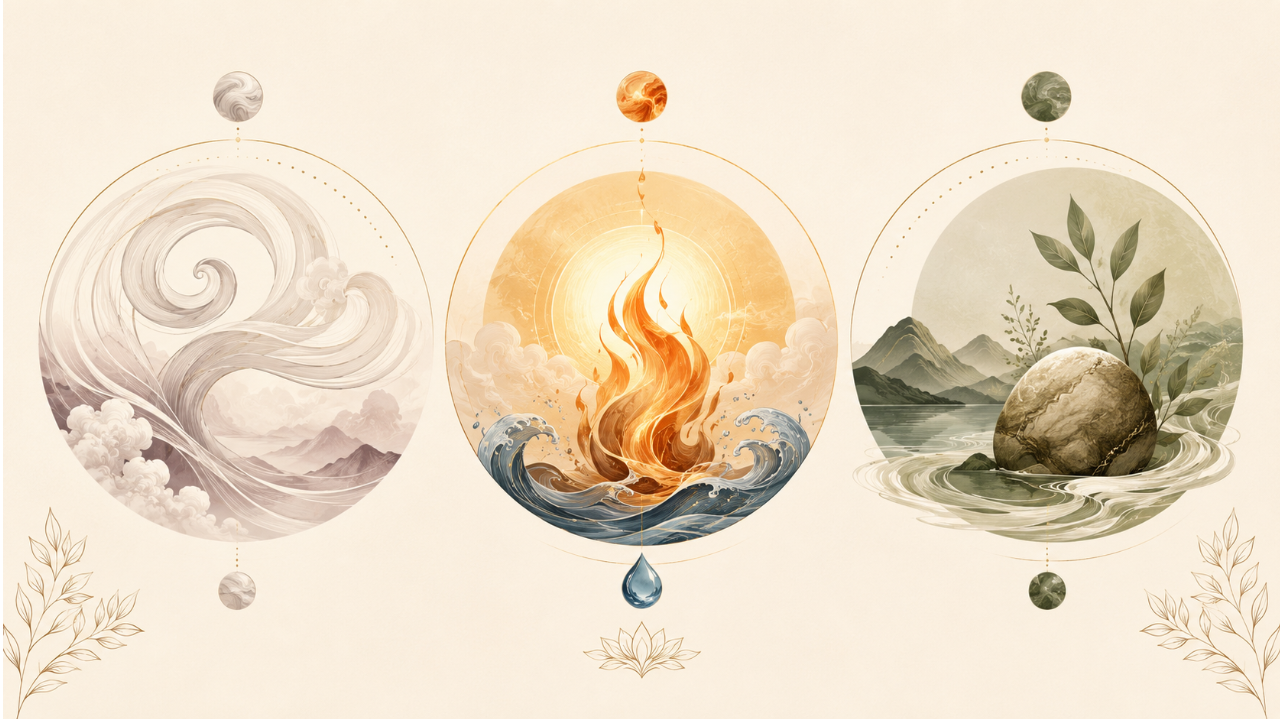
The same stress affects people differently because each person has a unique constitution, which Ayurveda describes through three doshas. Your environment may be similar to a colleague’s, but your constitution shapes how you respond.
Every person has all three doshas: Vata, Pitta and Kapha. One or two are usually more dominant, and that blend forms your natural blueprint.
Vata: air and space
Vata combines the elements of air and space and governs movement and communication. Its qualities are light, dry and mobile.
When Vata leads, you may be creative, spontaneous and adaptable. You might also notice variable energy, cold hands and feet, dry skin or finer hair. Under stress, Vata types may feel anxious, scattered or overwhelmed. The supportive direction for Vata is to warm, nourish and ground.
Pitta: fire and water
Pitta combines the elements of fire and water and governs digestion and transformation. Its qualities are hot, sharp and intense.
When Pitta leads, you may be focused, strategic and highly driven. You might run warm, have a strong appetite or notice skin that flushes easily. Under stress, Pitta types may feel irritable, critical or unable to stop. The supportive direction for Pitta is to cool, soften and rest.
Kapha: earth and water
Kapha combines the elements of earth and water and governs structure and stability. Its qualities are heavy, stable and moist.
When Kapha leads, you may be patient, loyal and deeply nurturing. You often have steady endurance, along with smooth skin and thick hair. Under stress, Kapha types may feel heavy, withdrawn or stuck. The supportive direction for Kapha is to move, warm and stimulate.
Bringing in the opposite quality
Ayurveda brings balance by introducing the opposite quality to whatever is in excess. The goal is not to become someone else but to return to your own balance.
In practice, that looks like this:
- Too much movement (Vata): warmth, steadiness and nourishment.
- Too much heat and intensity (Pitta): cooling, softness and permission to pause.
- Too much heaviness and stagnation (Kapha): movement, warmth and stimulation.
Ayurveda responds to the pattern, not just the pressure. If you are curious about your own tendencies, the Dosha quiz on our website is a gentle place to start, and a consultation can give you a fuller picture.
Five daily practices for sustainable wellness
Dinacharya is the Ayurvedic daily routine. In our blueprint it rests on five simple practices, and each one fits into an ordinary working day. Wellbeing grows through ordinary actions repeated consistently.
1. Pause and create moments of stillness
Pausing gives your nervous system a chance to receive the message you are safe. Try five slow breaths before your first client, sixty quiet seconds before driving home or a screen-free cup of tea.
Slow breathing has encouraging evidence behind it. In a 2025 randomised trial of slow-paced breathing with a longer exhale, 139 university students who did one short session reported lower stress straight afterwards than a control group. The effect was temporary, which is why a pause works best as a repeated habit.
Yogic breathing, known as pranayama, is the traditional form of this practice. Across randomised trials in people with diagnosed mental health conditions, a 2025 meta-analysis of pranayama linked the practice to short-term reductions in symptom severity compared with no active treatment. Side effects were more common with fast breathing techniques than slow ones, so gentle and slow breathing is the safer place to start.
2. Nourish and support Agni through mindful eating
In Ayurveda, nourishment depends on what your body can digest and absorb, not just what is on your plate. Agni, your digestive fire, is the term for that capacity.
Before you eat, ask yourself four questions:
- What am I eating?
- When am I eating?
- How am I eating?
- What state is my mind in?
Protecting a real seated meal is one of the simplest ways to put this into practice.
3. Oil and the practice of Abhyanga
Abhyanga is the Ayurvedic practice of warm oil massage, and it is more than a massage. Ayurveda considers warm oil to carry the opposite qualities to Vata: unctuous instead of dry, nourishing instead of depleted and grounding instead of constantly mobile.
At home, you can keep it simple. Oil your hands after work, your feet before bed, or your scalp and temples when you need to unwind.
Skip oil massage on broken or irritated skin, and patch test a new oil first. If you are pregnant or managing a health condition, check with your GP before starting.
4. Protect your senses
Protecting your senses means being intentional about what you take in each day. A few small shifts can help:
- Phone: put it away while you eat.
- Sound: choose silence sometimes.
- Light: dim your environment in the evening.
- Nature: rest your gaze on something living, even a pot plant.
Screens in bed deserve special attention. In the Sleep Health Foundation’s 2026 survey, 79.9% of Australians kept a phone or device in bed or within reach. Among 45,202 university students in Norway, one extra hour of screen use after going to bed was linked to 59% higher odds of insomnia symptoms and 24 minutes less sleep. That study shows a link rather than proof of cause, but putting your phone across the room is an easy experiment.
5. Honour your rhythm
A steady daily rhythm gives your body predictable anchors. Ayurveda suggests four anchors through the day:
- Wake: get up within the same hour each day.
- Eat: protect a real meal.
- Reset: pause between demands.
- Wind down: repeat a calming bedtime ritual.
Sleep regularity is drawing growing attention from researchers. In an Australian Raine Study analysis published in 2025, 768 middle-aged and older adults with less regular sleep reported lower physical and mental health-related quality of life. Researchers still need to test whether improving regularity changes those outcomes, but a consistent wake time is a low-risk habit worth trying.
A simple self-massage routine for real life
You can practise a quick self-massage routine in a few minutes, and it is designed to take home. Here is the sequence we practised together in Byron Bay:
- Hand massage after a demanding day.
- Foot massage before sleep.
- Head and temple massage when you need to unwind.
- Simple marma points for grounding, ideally learned first with a trained practitioner.
Marma points are specific points on the body that Ayurveda describes as junctions of energy. Gentle pressure is all you need, and you can stop at any point if something feels uncomfortable. Quick and practical, these rituals can act as small daily deposits into your Ojas.
How Ayurveda fits alongside your regular healthcare
Ayurveda works best as a complement to conventional medical care, not a replacement for it. If you have persistent low mood, sleep problems or physical symptoms, see your GP first. Let your GP know about any herbs or supplements you take, because some may interact with medicines.
Traditional medicine is gaining more structured global attention. In May 2025, the Seventy-eighth World Health Assembly adopted the WHO Global Traditional Medicine Strategy 2025-2034. Its priorities include building stronger evidence and ensuring safety and regulation. It also supports integrating traditional medicine into health systems where appropriate.
Some mind-body practices that pair well with an Ayurvedic routine also have new standing in Australia. Since 1 July 2025, amended private health insurance rules allow insurers to pay benefits again for seven natural therapies, including yoga and tai chi. Cover remains up to each insurer, so check your policy before you book.
When to reach out for more support
Reach out for professional support if stress is affecting your sleep, work or relationships for more than a couple of weeks. Your GP can talk you through your options and refer you on where needed.
If you ever feel overwhelmed or unsafe, call Lifeline’s 24-hour crisis support line on 13 11 14.
At Ayurvedic Wellness Centre, our consultations look at your constitution, your current patterns and your daily routine together. We work alongside your existing healthcare, never against it.
Wellbeing is cultivated one small daily choice at a time
Wellbeing is cultivated one small daily choice at a time, and you do not need a perfect routine to begin. Start with awareness before burnout, rhythm before depletion, and a little restoration every day.
Pick one practice from this blueprint, try it for a week and notice what changes. Health is not one perfect routine. It is the right support for your nature.
Note: This article is general information only. It is not a substitute for personalised medical advice, diagnosis or treatment.
Sources
- New work health and safety data demands stronger action to prevent harm – https://www.safeworkaustralia.gov.au/media-centre/news/new-work-health-and-safety-data-demands-stronger-action-prevent-harm
- Work stress fuelling Australians’ poor sleep, new Sleep Health Foundation data reveals – https://www.sleephealthfoundation.org.au/news-and-articles/work-stress-fuelling-australians-poor-sleep-new-sleep-health-foundation-data-reveals
- Brief slow-paced breathing improves working memory, mood, and stress in college students – https://pubmed.ncbi.nlm.nih.gov/40392328/
- Effectiveness of pranayama for mental disorders: a systematic review and meta-analysis of randomized controlled trials – https://www.frontiersin.org/journals/psychiatry/articles/10.3389/fpsyt.2025.1616996/full
- Effects of mindfulness and mindful eating on food intake and appetite: a systematic review and meta-analysis – https://openaccess.city.ac.uk/id/eprint/37909/
- Effect of Nitya-Abhyanga (self-massage) combined with stretching on hamstring extensibility, muscle stiffness, and stretch tolerance in college students: a randomized controlled trial – https://www.frontiersin.org/journals/sports-and-active-living/articles/10.3389/fspor.2026.1800782/full
- How and when screens are used: comparing different screen activities and sleep in Norwegian university students – https://www.frontiersin.org/journals/psychiatry/articles/10.3389/fpsyt.2025.1548273/full
- Health Related Quality of Life and Sleep Regularity Among Middle-Aged to Older Adults From the Community – https://researchnow.flinders.edu.au/en/publications/health-related-quality-of-life-and-sleep-regularity-among-middle-/
- Global Traditional Medicine Strategy 2025-2034 – https://www.who.int/teams/who-global-traditional-medicine-centre/traditional-medicine-strategy-2025-2034
- PHI 51/25 Private Health Insurance Legislation Amendment Rules (No. 5) 2025 – https://www.health.gov.au/news/phi-circulars/phi-5125-private-health-insurance-legislation-amendment-rules-no-5-2025
- Lifeline Australia – https://www.lifeline.org.au/